

You've got the idea, the domain name, maybe a logo. What you don't have is a single customer, a line of traffic data, or a market share to defend. That's exactly the situation where most competitor analysis advice falls apart — it assumes you already have something to compare.
So let me save you the wasted weekends. Conducting competitor analysis for a new business isn't a scaled-down version of what established companies do. It's a different job. You're not measuring your position against rivals; you're building your first map of the terrain before you take a single step onto it.
Here's what actually works, what I got wrong the first two times, and how to keep the whole exercise under a day.
Key Takeaways
- For a new business, the goal is orientation, not benchmarking — you have no baseline yet.
- Track three to five competitors, not fifteen. More than that and the map becomes noise.
- Your best data source at launch is customer reviews of your rivals, not their marketing pages.
- A first pass takes roughly four to eight hours. Do it before you finalize pricing, not after.
- The output that matters is a one-page table you actually update, plus three decisions it forces.
Why competitor analysis for a new business is a different animal
The standard playbook — market share, pricing gaps, feature matrices — assumes you have data of your own to compare against. You don't. A pre-launch business has no churn rate, no cohort, no average order value. Comparing your nothing to their something produces a document that reads well and decides nothing.
What you can do is borrow their history. Every established competitor has already run the experiments you're about to run: they've tested price points, they've discovered which customer segment complains loudest, and their review pages are a public record of where they've failed people.
The real question isn't "who are they"
It's "where are they leaving room." A competitor with a mediocre product and excellent distribution is telling you something useful: the market tolerates mediocre products when the logistics are smooth. If you can't out-logistics them, you need a different wedge.
I built a small service business a few years back and spent two evenings building a feature-by-feature spreadsheet against four local rivals. It felt productive. Then a mentor asked me one question that killed the whole thing: "Which of these features would a customer actually switch for?" I had no answer. Half the rows were things nobody had ever mentioned in a review. Build the map around customer language, not your own feature list.
What are the 5 steps of a competitive analysis?
The five steps, in the order that actually makes sense for a business with no history: define the arena, pick your rivals, gather evidence from reviews and public pages, compare on the criteria customers care about, then turn it into decisions. Skip any one and the rest degrades — a badly defined arena gives you the wrong rivals, and wrong rivals give you a comparison nobody cares about.

Step 1: define the arena before you name a single competitor
Write one sentence: "A customer choosing us is currently choosing between ___ and ___." Fill those blanks with the actual alternatives, which are often not other companies. For a new meal-prep service, the alternatives are a rival service, a supermarket, and cooking at home. Only one of those is a company you can study.
Step 2: pick three to five rivals, no more
- Two direct — same offer, same customer.
- One indirect — different method, same underlying need.
- One you'd never want to become, but who wins anyway. This one teaches you the most.
Step 3: gather evidence where it's free
Their homepage tells you what they want you to believe. Their reviews tell you what's true. Read the two- and three-star reviews specifically: five-star reviews are thank-yous, one-star reviews are often about delivery or a refund policy, but the middle reviews describe the gap between promise and delivery. That gap is your opening.
Step 4: compare on the criteria customers actually use
Not on your feature list. On theirs. Pull the recurring phrases out of reviews and count how many rivals fail at each. Price, turnaround, communication, quality consistency, ease of first use — the list is usually shorter than people expect.
Step 5: force three decisions out of it
A table that doesn't change what you do is decoration. Set a rule: the analysis must produce a pricing decision, a positioning sentence, and one thing you deliberately won't do. If yours produces fewer, you haven't finished.
What is the best tool for competitor analysis?
Honestly? A spreadsheet and a folder of screenshots. For a pre-revenue business, paid competitive-intelligence platforms are the wrong spend — they're built to monitor a position you don't yet have, and the free tiers of the bigger search tools give you more than enough for a first pass.

What to use in practice
- A spreadsheet — one row per competitor, one column per criterion. This is the backbone.
- Their public review pages — read them, don't just scan the star average. I copy the exact phrasing of complaints into a column; it becomes ad copy later.
- A screenshot folder — capture their pricing page every few weeks. Prices change and the change itself is information.
- Wayback Machine — lets you see what they launched with versus what they sell now. The pivot is often the most revealing artifact.
The catch? All of this is manual, and it takes a few hours. That's fine. You'll learn more reading thirty reviews by hand than you will from any dashboard's summary — because the summary flattens the language, and the language is what you're mining.
Can you do a SWOT analysis on a competitor?
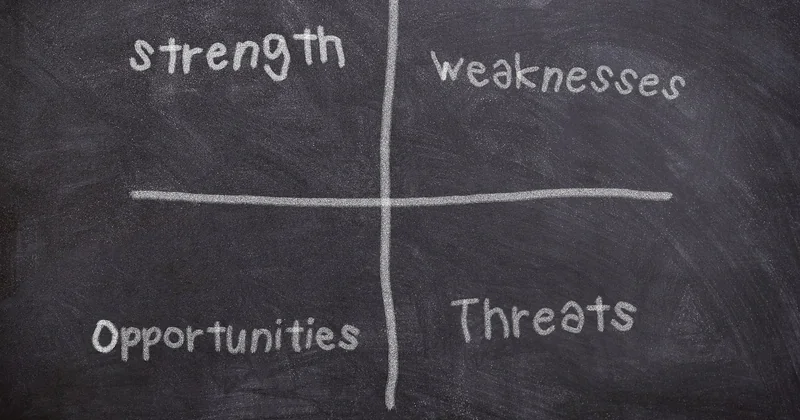
Yes, and it's one of the few frameworks worth keeping — provided you treat it as a set of questions rather than four boxes to fill. The usual failure is a SWOT that becomes a list of adjectives: "strong brand, weak mobile app." Useless.
Making SWOT earn its keep
Force each quadrant to cite a source.
- Strengths — where do their reviews repeat praise? That's observable.
- Weaknesses — the two- and three-star complaints, verbatim.
- Opportunities — segments their own marketing ignores. Look at who they don't address on their homepage.
- Threats — what happens to you if they copy your differentiator next quarter.
That last box is the one people skip, and it's the one that matters most for a new entrant. If your only wedge is something a competitor could replicate in a week, the SWOT just told you your business is fragile.
How to write competitive analysis in a business plan?
Two pages, maximum. Whoever reads your plan — an investor, a bank, a grant committee — is scanning for one thing: whether you understand the field you're entering. Long competitive sections read as padding; precise ones read as competence.
A structure that gets read
- The arena — one paragraph on how customers solve this problem today.
- The table — three to five competitors, four or five criteria, plus a column for you.
- The gap — the specific weakness in the field you're built to address, backed by review evidence.
- The risk — what happens if a competitor responds, and why you still win.
The table itself
| Criterion | Competitor A | Competitor B | Your business |
|---|---|---|---|
| Entry price | Mid-range, tiered | Cheapest tier, upsells hard | Slightly above A, single plan |
| Onboarding time | Days, requires a call | Instant, self-serve | Instant, with a manual check |
| Recurring complaint in reviews | Slow support replies | Quality varies by order | — |
| Who they ignore | Small buyers | Anyone wanting a contract | Small buyers wanting a contract |
Notice the "who they ignore" row. That single line does more persuasive work than a page of prose, because it points directly at your reason for existing. Keep the table honest — claim nothing about your own column you can't yet deliver.
Three mistakes I made so you don't have to
The first: I analyzed competitors before I'd talked to a single potential customer. The result was a beautiful comparison of things nobody had asked for. Talk to five people first, then go read reviews. The reviews will suddenly make sense.
The second: I treated the analysis as a one-time event. Six months in, two of my "competitors" had pivoted and a new entrant had undercut everyone on price. My map was a year out of date and I hadn't noticed.
The third, and the most expensive: I copied a competitor's pricing structure because it looked considered and professional. It was designed for their cost base, not mine. I repriced within four months.
How often should you redo this?
A full pass every six months is plenty for a small business. In between, keep a lightweight watch — the screenshot folder, plus a note any time a customer mentions a rival by name. That note is worth more than any quarterly report.
None of this is glamorous. A spreadsheet, a few hours of reading complaints, and three decisions you're willing to commit to. But it's the difference between launching into a market you've actually looked at, and launching into the one you imagined. The map won't be complete — it never is, and the terrain will shift under you anyway. What matters is that you drew it yourself, because the act of drawing is where the understanding actually lands.


